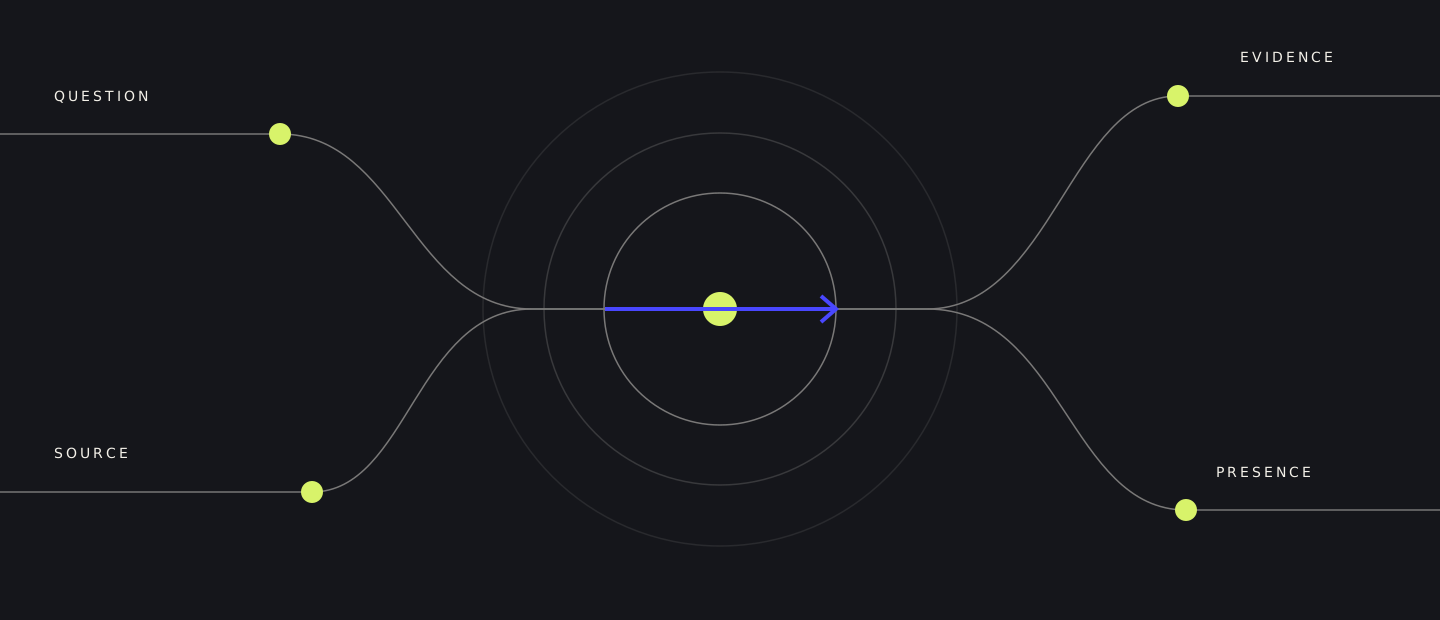
A GEO audit should explain how your business appears for an agreed set of AI search questions and identify changes worth making. You should finish it with enough detail to assign the next piece of work. That evidence-led approach underpins GEO Agency’s work.
The audit will have limits. A provider can’t observe every answer shown to every customer. The scope should explain the sample and what can reasonably be concluded from it.
That makes the first conversation especially important. Before someone starts collecting screenshots, agree on the business question the audit is supposed to answer. We scope the assessment separately from implementation in our GEO services so that question can be answered before the next commitment.
Define the part of the business you care about
Imagine a company that sells employee-training software. It serves several markets, but the current sales priority is onboarding hourly workers in retail.
An audit covering every possible training question could become large and unfocused. A better first scope might investigate how a buyer researches onboarding software for a multi-location retailer.
The company can then supply the details that matter to the buying decision. Perhaps deployment speed is important. Perhaps the system needs to work on devices staff already own. The audit should use the actual product facts, rather than assume every competitor offers the same thing.
Write this scope down. It gives both sides a way to reject interesting findings that don’t help answer the agreed question.
Keep an evidence record somebody else can inspect
The provider should preserve the questions tested and the observed answers, with the relevant conditions and dates. It should distinguish whether the business was mentioned from whether a page was cited.
For the hypothetical training company, the record might show that a competitor appeared in an answer about mobile access. The cited source might be a product directory. The next step is to inspect that directory and determine what information supported the answer.
That investigation could reveal a relevant product difference. It could also reveal a stale listing. Those findings lead to different recommendations.
An audit should explain when an observation could not be reproduced. Hiding the inconvenient runs makes the evidence harder to trust and the apparent opportunity easier to exaggerate.
Inspect your own information alongside outside sources
The company may have a strong feature that is buried in an old release note. Its main product page may describe the feature too vaguely for a buyer to evaluate it.
The auditor should connect that gap to a specific page and ask who can confirm the facts. A useful recommendation could be to add an approved explanation of mobile access to the product page, with a link to the setup documentation.
The outside-source review needs the same specificity. If a directory entry is outdated, name the entry and the correction required. If a publication already has an appropriate review process, explain what material the company would need to submit.
“Build authority” doesn’t tell your marketing manager what to do on Monday.
Turn findings into assignments
For each recommendation, identify an owner and the evidence supporting the change. Include dependencies that could delay it.
A compact example might look like this:
| Finding | Proposed action | Responsible person | Dependency |
|---|---|---|---|
| Mobile access is described inconsistently | Correct the product page and directory entry | Product marketing lead | Product team confirms current support |
| A relevant buyer question has no useful answer | Add a worked explanation to an existing page | Content lead | Approved example from product specialist |
The table is an illustrative format, not a report from a real client.
Prioritization should consider effort and business relevance. You don’t need every finding turned into a new page. Some will be better handled by updating information that already exists.
Agree on how you’ll review the changes
An audit should leave a baseline you can revisit. Keep the original question set and record when the recommended changes go live.
Where available, first-party platform reports can add evidence. Bing introduced AI citation reporting in February 2026, for example. That report covers supported Microsoft experiences rather than every platform in the audit. Microsoft describes its scope here.
At a later review, compare the observations with the baseline and discuss the uncertainty. Changes elsewhere in the market may affect the answers too.
Bring the people responsible for implementation to the final audit review. Ask each person whether they have enough information to complete the work assigned to them. Any unanswered question belongs back with the auditor before you close the engagement.